Sexual Health · Guide
The Best Male Wellness Routines After 40
Most "after 40" advice is a list of twenty things. Here are the six that carry the weight, ranked by evidence, plus what to actually buy for each.
✓ Medically reviewed by Dr. Justin Houman, MD, Board-Certified Urologist, Cedars-Sinai
Dr. Houman is a co-formulator of JOYMODE Hard+, a product reviewed on this site.
Something changes in your forties, and it is rarely one dramatic thing. Recovery takes an extra day. The gym pump fades faster. Blood pressure creeps into the range where your doctor mentions it. And the one system that depends most completely on circulation becomes less predictable than it used to be.
The advice industry responds to this with lists of twenty habits. Most of those twenty have almost no evidence behind them, and the effort you spend on them is effort taken from the four or five that do.
So this is the short list. Six things, in rough order of how much they change, with what to buy for each — and honest notes on where the evidence stops.
1. Move your blood pressure before anything else
Nothing else on this list has the evidence base that blood pressure does. It is a leading modifiable risk factor for cardiovascular disease and stroke, it produces no symptoms until it produces a serious one, and it is the cheapest number in medicine to measure.
Buy a $40 upper-arm cuff. Measure seated, arm supported at heart height, after five minutes of sitting still, and average two or three readings. A single reading taken in a clinic waiting room is a noisy measurement and often a misleading one.
What moves it: aerobic exercise, bodyweight, sodium, alcohol, sleep. Also medication, which is cheap and works well — a conversation worth having rather than avoiding.
This one is free, and skipping it to buy supplements is the most common mistake in this entire category. Start with the five biomarkers worth tracking.
2. Lift something heavy, twice a week
Grip strength predicts all-cause mortality and functional decline in older adults, and it predicts them because it tracks the muscle and strength you are carrying. Muscle is the tissue you spend your forties either building or quietly losing.
Two sessions a week covering the major movement patterns is enough to change the trajectory. The returns are steepest for the least trained, which is the good news if you are starting from nothing.
Creatine monohydrate is the one supplement with a genuinely strong evidence base here — decades of human trials, roughly 3–5 g daily, no loading phase required, and cheap enough that the branded versions are hard to justify. See creatine after 40.
3. Eat enough protein, and fix breakfast
The RDA of 0.8 g/kg is a floor designed to prevent deficiency, not a target. Research on building and preserving muscle lands closer to 1.6 g/kg — roughly 130 g for a 180-pound man.
This matters more with age, not less. Older adults become less responsive to a given dose of protein, so the amount needed to trigger the same muscle-protein response rises. The group most likely to be under-eating protein is the group least able to afford it.
The meal almost everyone under-eats is breakfast. Fix that one meal and most of the gap closes. Full detail in how much protein you actually need.
4. Support the circulation your erections depend on
An erection is a plumbing event before it is anything else. Blood has to arrive quickly and stay. The signal that makes that possible is nitric oxide, which tells the smooth muscle lining your blood vessels to relax so they widen.
Nitric oxide production declines with age. That is not a disease — it is a slope, and it is the same slope that shows up as flatter pumps and colder hands.
Two things are worth knowing before you buy anything in this category.
Citrulline, not arginine. Arginine is the direct precursor to nitric oxide, which makes it the obvious thing to supplement and the wrong thing to supplement: an enzyme called arginase destroys most of an oral dose before it reaches your bloodstream. Citrulline bypasses that and converts to arginine downstream. The full explanation is here.
Daily, not before. Every useful trial in this area measured daily supplementation over weeks. A 2011 trial in Urology found roughly a 50% improvement in erectile function scores after one month of daily L-citrulline in men with mild dysfunction (PubMed 21195829). That is a study about a month of consistency, not about timing a dose to an evening.
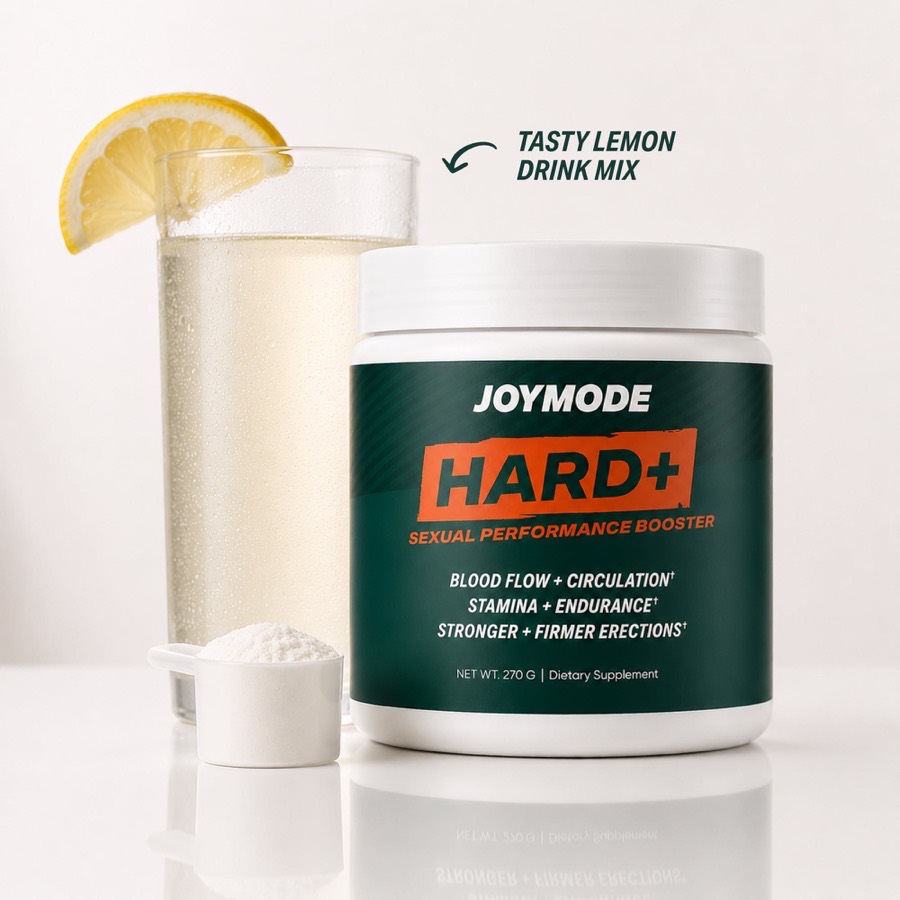
Our pick — daily blood flowWe own this
JOYMODE Hard+
The only widely available formula we have found that pairs a genuine 4 g citrulline dose with a second nitric oxide pathway and discloses every amount on the label.
- Format
- Lemonade drink mix, 30 daily sachets
- Price
- $84.99 / 30 servings ($2.83 per day)
- Dose
- 4,000 mg L-citrulline + 2,500 mg arginine nitrate (NO3-T®) + 300 mg Panax ginseng (7% ginsenosides) + 100 mg vitamin C
- Third-party tested
- cGMP-certified, NSF-registered facility (USA)
Four grams of citrulline is the number that matters. Most of the shelf sits at a fraction of it, or hides the amount inside a proprietary blend — and a blend that will not tell you the amount is a blend where the amount is the reason. Compare the field in our nitric oxide supplement review.
What it is not: it does not produce an automatic erection, and it is not a treatment for erectile dysfunction. It supports your body's own response; arousal is still required. If you take nitrates, blood pressure medication, or a PDE5 inhibitor such as sildenafil or tadalafil, talk to your doctor before adding anything that acts on blood vessels.
5. Treat desire as a separate system from capability
This is the part most "after 40" routines skip, and it is the part that most often turns out to be the actual problem.
Blood flow determines whether your body can. It has very little to do with whether you want to. Desire runs on a different set of inputs — stress load, sleep debt, relationship context, alcohol, and how safe and unhurried the situation feels. Men are rarely told this, so a drop in desire gets misread as a physical failure and treated with a circulation product that was never going to address it.
If the honest answer is that you want to less often rather than that you can't, start there instead. What actually affects libido covers the inputs, and it is the cheaper problem to work on.
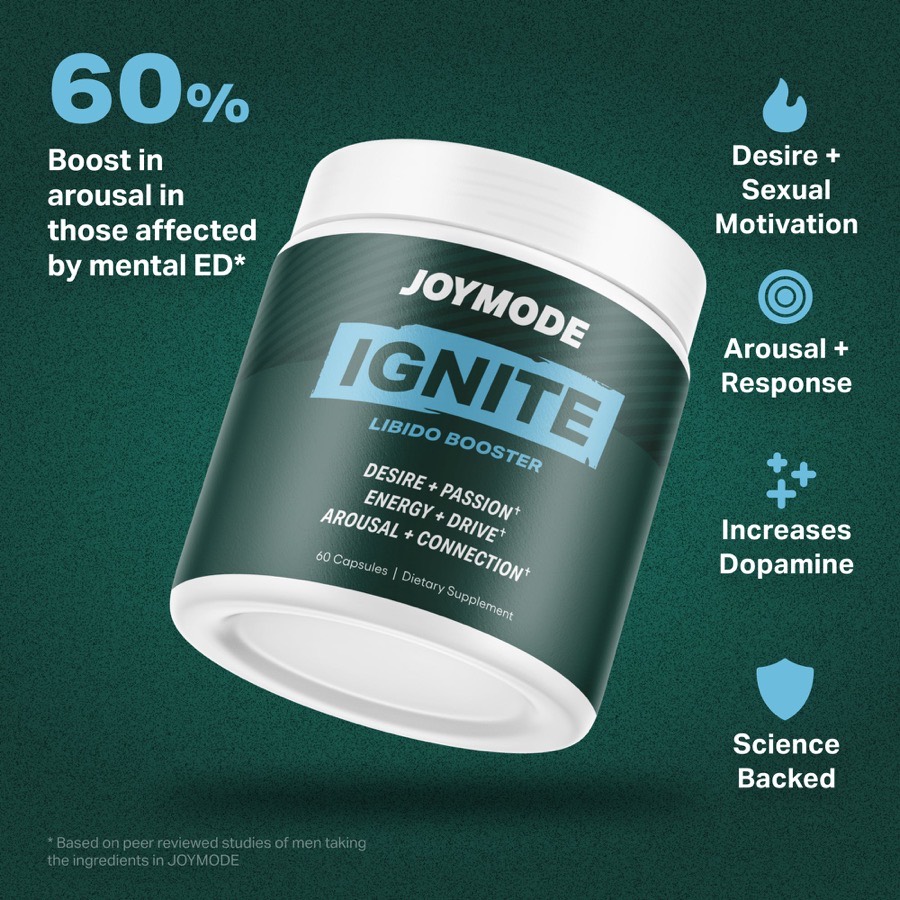
For desire, not blood flowWe own this
JOYMODE Ignite
A different job from Hard+ — saffron and a dopamine-side approach rather than a vascular one. Worth understanding as a separate category rather than a stronger version of the same thing.
- Format
- Daily capsule
- Price
- From $54.99
6. Protect your skin, because it is the visible one
Everything above is invisible. This one is the thing people actually see, and the intervention is almost comically cheap.
Daily broad-spectrum sunscreen does more for how your face ages than every serum stacked on top of it. SPF 30–50, broad spectrum, in a texture you do not resent putting on — because the variable that decides the outcome is how many days you skip. What actually matters in sunscreen is three things, and SPF number is the least important of them.
For everything else: a fragrance-free moisturizer with ceramides, and a retinoid if you want the one active with real evidence for texture and fine lines. That is a complete routine. Anything beyond it is optional.
What we left off, and why
- Testosterone boosters. The category is mostly underdosed or relying on a single small trial. Ashwagandha at a standardized 300–600 mg has the most respectable evidence, and the effect sizes are modest. If you suspect low testosterone, measure it rather than guessing at it with a supplement.
- NAD+ and NMN. Genuinely interesting mechanistically, and the human outcome data is not there yet. See NAD+ and NMN.
- Cold plunges, red light, most recovery hardware. Pleasant, popular, and thin on evidence for the outcomes they are sold against.
- Multivitamins. Not harmful, rarely the constraint.
The whole routine, in six lines
- Measure your blood pressure at home. Act on it.
- Lift twice a week. Add creatine, 3–5 g daily.
- Get protein to ~1.6 g/kg. Fix breakfast.
- Support nitric oxide daily — 4 g citrulline, taken every day, not before.
- If the issue is desire rather than capability, work on that instead.
- Sunscreen every morning. Moisturizer at night.
Five of those six cost almost nothing. That ordering is deliberate: the free interventions are the ones with the strongest evidence, and the supplement is the one that only makes sense once the rest are in place.